
Medical Billing Software for Clinics
OmniMD medical billing software achieves 97% clean claim rates with AI claim scrubbing and predictive denial scoring. Prior authorization turnaround drops from 10 days to 2 hours. Days in AR falls below 30 days for most practice types within two billing cycles.
Redefining Medical Billing Software Excellence
Accounts Receivable
A focused, time-bound initiative to recover aging receivables and accelerate medical AR recovery. We segment and prioritize portfolios, apply proven AR follow-up workflows, and align with write-off governance to improve cash flow, reduce days in AR, close legacy balances, and strengthen financial hygiene across the healthcare revenue cycle.

Staffing Backfill
Rapid deployment of skilled revenue cycle management staffing and certified medical billing talent to stabilize operations during workforce gaps. Our resources integrate efficiently into your existing RCM workflows, sustaining productivity and minimizing disruption across billing, coding, and AR functions.

Analytics & Insights
A full-spectrum RCM analytics and reporting layer that turns raw data into actionable intelligence. We track core revenue cycle KPIs, AR Days, Denial Rate, Net Collection Rate, Clean Claim Rate, and DNFB (Discharged, Not Final Billed), enabling smarter decisions that improve cash flow, operational efficiency, and financial performance.

Medical Billing Software for Small Clinics
A fully integrated and accountable end-to-end medical billing solution for small practices. We manage registration through final payment using standardized RCM processes, automation tools, and compliance-first workflows. Our outcomes focus on cash acceleration, denial prevention, clean claim submission, and sustainable collection efficiency, purpose-built for small medical practices.
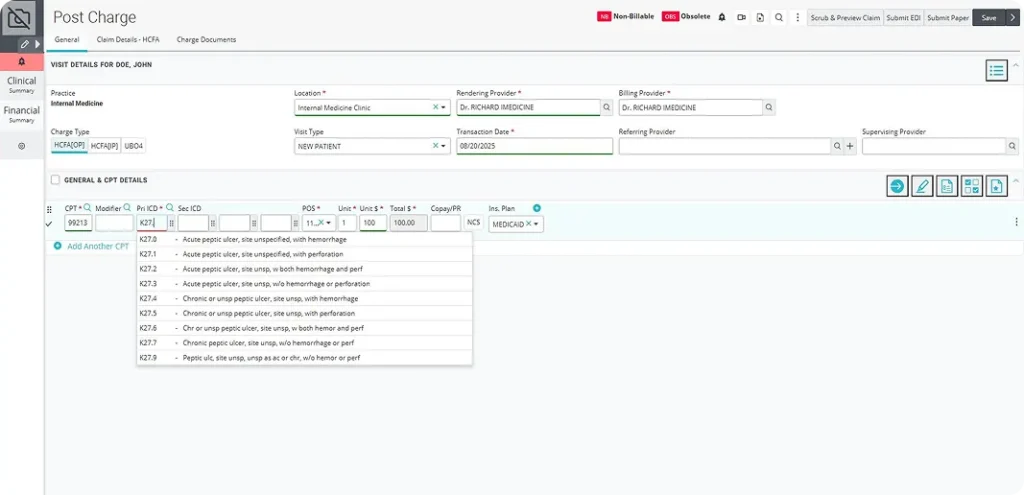
Financial Clearance Services
Pre-service rigor powered by automated insurance eligibility verification, benefits confirmation, prior authorization management, and accurate patient cost estimates. This front-end financial clearance model reduces downstream denials, enhances patient financial transparency, and maximizes point-of-service collections.
Coding Support Services
Certified medical coders and reliable QA protocols ensure compliant medical coding services, accurate clinical abstraction, and payer-compliant documentation. We strengthen audit readiness, reduce coding-related denials, support HCC, E/M, CPT, ICD-10 accuracy, and optimize reimbursement integrity.

Accounts Receivable Follow-Up
Strategic AR follow-up services customized by payer patterns and account age. Our targeted workflows improve aging metrics, increase recovery, and reinforce upstream documentation and claim submission practices, reducing rework and preventing recurring AR issues.

Denials Management
A proactive denial prevention and resolution framework that addresses root causes, strengthens clean claim submission, and accelerates appeals. We reduce denial rates, improve overturn ratios, and implement denial management automation and corrective controls that prevent recurrence, ensuring faster reimbursement and predictable revenue.

MIPS & MACRA
A solution that makes monitoring, tracking, and reporting performance easier, helping healthcare organizations stay compliant and optimize their outcomes in value-based care programs. It turns complex requirements into simple, actionable insights for every team member. learn more


Get 98% Claim Accuracy with Cloud-Based Medical Billing Software
Gain line-level clarity, predictive denials intelligence, and optimized work queues that prioritize action by impact with our cloud-based RCM software that delivers consistently high clean claim rates without compromising cycle speed or compliance. By unifying payer rules, charge integrity checks, and clinical documentation alignment into one adaptive ecosystem, it eliminates fragmented workflows that lead to denials.
Embedded AI continuously learns from remittance trends and payer behavior to fix revenue leakage. The system dynamically tunes edits and scrubbing protocols based on specialty, locality, and regulatory shifts with no manual rule-setting needed.
Experience the OmniMD Advantage
Real Stories From Medical Practices Thriving With OmniMD
After comparing many EMRs, I determined that OmniMD was the best software for my new clinic. I run a high volume family practice clinic. OmniMD is used for scheduling, reminder calls, medical records, insurance and patient billing. OmniMD is a critical tool for my practice. It is a very good software, but I am also very pleased with the level of service OmniMD provides with their technical support team.

Our practice has been very pleased with the outcomes of your billing and collection services. You have been both informative and patient as we continue to become a more efficient practice. We have recognized that collections have been improved due to your diligence and tenacity. Thank you for your kindness and hard work.
OmniMD’s EHR and Billing software has truly streamlined our operations at Solid Sobriety. Their billing tools have improved our efficiency, significantly reducing errors and boosting revenue. What stands out most is their exceptional customer support- the team is always available, knowledgeable, and proactive in solving any challenges we face. We couldn’t be happier with the partnership.
Hello, I’m Eman, for the past 10 years, OmniMD has been instrumental in transforming our billing operations. The reduction in claim denials and the ease of handling claims have not just streamlined our work but have also allowed us to focus more on patient care. The efficiency and reliability that OmniMD offers are unparalleled, and it has been a vital component of our practice’s success.

OmniMD has proven to be reputable and reliable. Although it was not a smooth start with the initial billing and claims process. They were readily available to quickly worked with me and rectified any issues that may arise. I was quickly assigned to one of the best billers, and it has made big difference in my practice revenue. OmniMD values customer satisfaction and will go above and beyond to maintain a positive and productive relationship. They have my trust!




How Medical Billing Software Works End-to-End
Medical billing is a multi-step process that starts the moment a patient is scheduled and ends when the last dollar is collected. Each hand-off point is an opportunity for revenue loss if the system does not have the right checks in place. Understanding where money leaks helps you evaluate whether your current platform actually prevents it or just processes transactions.
The standard billing workflow runs through six stages: charge capture (translating clinical services into billable codes), claim scrubbing (running NCCI edits and payer-specific rule checks before the claim leaves the practice), EDI 837 submission to the clearinghouse, electronic remittance advice (ERA) receipt via EDI 835 when the payer pays, payment posting and contractual adjustment reconciliation, and accounts receivable follow-up for unpaid or partially paid claims.
Industry data from Change Healthcare shows the average physician practice denial rate is 11 percent. At that rate, a practice billing $2 million annually is sending out $220,000 in claims that will be rejected on the first pass. Of those denied claims, 65 percent are never resubmitted, per Advisory Board research. That revenue disappears permanently. OmniMD’s integrated EHR and billing platform is built to intercept these losses before a claim touches the clearinghouse.
The clearinghouse receives claims in EDI 837 format. When an 835 electronic remittance comes back from the payer, OmniMD auto-posts the payment, applies the contractual adjustment, and flags any underpayment against the negotiated fee schedule. This closes the loop from submission to posting without manual intervention for the majority of claims.
How OmniMD’s AI Claim Scrubbing Catches Errors Before Submission
Payers now use AI to find reasons to deny or reduce claims. OmniMD uses AI on the practice side to find those same reasons before the claim leaves your system. The scrubbing engine applies three layers of checks to every claim: National Correct Coding Initiative (NCCI) bundling edits that identify code pairs payers will not reimburse separately, local and national coverage determinations (LCD/NCD) that flag procedures lacking documented medical necessity for the attached diagnosis, and payer-specific rules that vary by insurance contract and are updated continuously as payers revise their adjudication logic.
The HFMA benchmark for a best-in-class medical billing operation is a 97 to 98 percent clean claim rate. A clean claim is one that passes all edits on first submission with no missing information, no code conflicts, and no documentation gaps. Every percentage point below 97 percent represents rework. MGMA data puts the average cost to rework one denied claim at $25 to $30 when staff time and resubmission overhead are included. For a practice receiving 500 denials per month, a 2 percent improvement in clean claim rate eliminates roughly 120 rework events monthly, saving approximately $3,000 per month in administrative cost alone.
OmniMD’s AI revenue cycle management system also applies a predictive denial score to each claim before submission. Claims that match historical denial patterns for a specific payer receive a risk flag. The billing team reviews flagged claims before submission rather than after rejection, which is the most cost-effective intervention point in the revenue cycle.
“During a workflow review with a multi-specialty group that had been running an 89 percent clean claim rate on their previous platform, I traced the gap to three recurring patterns: modifier 25 missing on E/M visits paired with same-day procedures, CPT 99213 coded without supporting documentation depth for the attached diagnosis, and coordination of benefits issues on secondary payer claims. OmniMD’s scrubbing rules caught all three categories on the test batch before any claim left the system. The group’s clean claim rate reached 96 percent within 60 days of go-live.” – Dr. Giri Rajtosh Purohit, Product Owner, OmniMD. Verified on June 26, 2026.
OmniMD’s AI medical coding engine supplements the scrubbing layer by suggesting the correct CPT and ICD-10 codes based on the clinical documentation. This is particularly valuable for E/M level selection after the 2023 AMA revisions, where time-based and medical decision complexity rules changed substantially.
Prior Authorization Automation: From 10 Days to 2 Hours
Prior authorization is the single most disruptive administrative burden in medical billing today. The average prior authorization request takes 10 business days to complete through manual fax-and-follow-up workflows, delaying care, frustrating patients, and tying up clinical staff on the phone with payer representatives. OmniMD’s prior authorization automation platform reduces that timeline to approximately 2 hours for eligible procedures through payer portal connectivity and AI-driven clinical criteria matching.
The system works by pulling the clinical criteria required by the payer for the specific procedure code, matching them against the documentation already in the patient’s chart, and submitting the authorization request electronically. When the clinical documentation is complete and matches payer criteria, the authorization returns in hours rather than days. When documentation is incomplete, the system identifies the specific gap so a physician or nurse can address it in minutes rather than having the request sit in a queue for days before a denial is issued.
For specialties with high prior authorization volume, such as orthopedics, cardiology, oncology, and radiology, the time savings translate directly into procedure capacity. A practice that schedules 50 prior auth requests per week and reduces average turnaround from 10 days to 2 hours recovers the equivalent of more than a full-time staff member’s work week in administrative time. That staff capacity can shift to patient-facing tasks or denial appeals rather than hold-queue phone calls.
The pre-authorization module integrates directly with the scheduling workflow so that authorization status is visible at the time of appointment booking and updated in real time. Appointments are not confirmed until authorization is secured, eliminating the situation where a patient arrives for a procedure that was never authorized.
Denial Management: Lowering Your Denial Rate and Raising Your Overturn Rate
Most billing software vendors report denial rate as the key metric. Denial rate alone does not tell you enough. A practice can have a 10 percent denial rate and a 20 percent overturn rate (meaning only one in five appealed denials is overturned) and lose the majority of that revenue permanently. The metric that actually matters is the combination: how many claims were denied, and what percentage of those denials did you recover through appeals and resubmission.
Advisory Board research shows 65 percent of denied claims are never resubmitted. The main reason is that the appeal process is time-consuming and the outcome is uncertain. OmniMD’s AI denial management system changes the economics of appeals by automating the appeal letter generation, pulling the supporting documentation from the patient chart, and routing the appeal to the correct payer contact based on denial reason code. This reduces the per-appeal time from 45 to 60 minutes of manual work to approximately 10 minutes of review and submission.
On the prevention side, OmniMD tracks denial patterns by payer, CPT code, diagnosis code, and provider. When a payer begins denying a specific code combination that it previously paid, the system identifies the pattern within two to three weeks and updates the pre-submission scrubbing rules to flag future claims with the same profile. This proactive feedback loop prevents recurring denials on the same issues, which is the difference between a billing system that reacts to the revenue cycle and one that shapes it.
OmniMD practices report recovering an average of $150,000 per year in revenue that would have been written off under their previous billing process. That figure comes primarily from two sources: claims that were previously never resubmitted after denial, and underpayments that were posted at the payer-stated amount without being compared against the contracted fee schedule.
Days in AR: The Single Number That Tells You How Healthy Your Revenue Cycle Is
Days in accounts receivable (Days in AR) measures how long it takes, on average, to collect payment after a service is rendered. It is calculated by dividing total outstanding AR by average daily charges. The lower the number, the faster cash is moving through the practice. MGMA data puts the median Days in AR for physician practices at approximately 35 days. High-performing practices in the top quartile for billing efficiency run at or below 25 days.
Days in AR rises when claims are submitted late, when denials are not worked promptly, when patient balances are not collected at the time of service, or when the AR aging bucket above 90 days grows unchecked. The 90-plus-day bucket is the most important number to watch: claims older than 90 days have collection rates that drop sharply with every passing week, and some payers have timely filing limits that permanently bar resubmission after a certain threshold.
OmniMD’s practice management platform displays AR aging by bucket (0 to 30, 31 to 60, 61 to 90, and 90-plus days) with drill-down to individual claims. Automated follow-up tasks are assigned to billing staff based on account age and payer priority, so high-value aging claims receive attention before timely filing deadlines expire. The system also tracks Days in AR as a running dashboard metric so the practice administrator and physician owner can see the trend in real time rather than at month-end only.
The goal is to keep Days in AR below 30 for most practice types. OmniMD practices that implement the full claim scrubbing, prior auth automation, and denial follow-up workflow typically see Days in AR drop 5 to 8 days within the first two billing cycles.
ERA, EDI 835, and Automated Payment Posting
When a payer processes a claim and issues payment, it sends back an Electronic Remittance Advice (ERA) in the EDI 835 format. The 835 file contains the payment amount, the contractual adjustment, any denial reason codes, and the patient responsibility amount. For practices still manually entering this data from paper Explanations of Benefits (EOBs), payment posting can take one to two full days of staff time per week for a medium-volume practice.
OmniMD’s ERA auto-posting module ingests the 835 file directly from the clearinghouse and posts payments to the correct claim line without manual data entry. Contractual adjustments are applied based on the payer-specific fee schedule loaded in the system. Any payment that falls below the contracted amount triggers an underpayment flag so the billing team can review and dispute it before the appeal window closes. This is the underpayment recovery workflow described in OmniMD’s billing KPI resources. Practices routinely discover they have been accepting partial payment as full payment because the comparison against the contracted rate was never automated.
Patient responsibility amounts from the 835 file are pushed automatically to the patient statement queue. Patients receive a statement that matches exactly what the payer posted, eliminating the common problem of patients receiving bills that do not match the EOB they received from their insurance company. OmniMD’s integrated EHR and billing system maintains the complete payment timeline from charge entry through ERA posting to final collection in a single record that the practice can pull for any audit or patient inquiry.
Real-Time Eligibility Verification Before Every Appointment
Eligibility errors are the leading cause of front-end denials. A patient’s insurance status can change between when an appointment is booked and when the patient arrives. A plan termination, a change in group number, or a lapse in premium payment can all result in a claim denial that has nothing to do with the clinical documentation or the codes billed. Catching these issues before the appointment takes minutes; chasing them after the claim is denied takes days.
OmniMD runs an automated 270/271 eligibility transaction for every scheduled patient 24 to 48 hours before the appointment. The verification returns the patient’s active coverage status, co-pay amount, deductible balance, out-of-pocket maximum, and whether a referral or prior authorization is required for the scheduled service. This information is displayed in the scheduling and check-in workflow so front desk staff can collect the correct co-pay at the time of service and alert the patient to any authorization requirements before the visit begins.
For practices with high Medicare and Medicaid volumes, OmniMD also runs eligibility checks against secondary payers as part of the coordination of benefits workflow. Secondary payer information is captured at the time of registration and updated automatically when primary payer EOBs indicate secondary coverage exists. This prevents the common revenue leak where secondary payer claims are never submitted because the billing team did not know secondary coverage was active.
Medical Billing Software vs. Outsourced RCM: Which Is Right for Your Practice
The decision between managing billing in-house with software and outsourcing to a managed RCM service depends on practice size, internal billing staff experience, specialty billing complexity, and the practice’s tolerance for managing vendor relationships. Neither option is universally better. The right answer depends on where your revenue loss is currently happening and what your team has capacity to manage.
In-house billing with strong software works best for practices with at least one experienced billing manager, stable payer mix, and the administrative bandwidth to work denials and manage AR aging. The software provides the tools; the internal team provides the judgment. When the software is well-configured and the billing team is experienced, in-house billing typically costs 4 to 6 percent of collections in labor and software combined, which is lower than full outsourcing fees (typically 6 to 10 percent of collections).
Outsourced RCM is the right choice for practices that have experienced significant billing staff turnover, have an AR aging profile with more than 20 percent of balances over 90 days, or are in a specialty with highly complex billing (surgical specialties, behavioral health, radiation oncology) where specialized coder expertise is required that the internal team cannot maintain. OmniMD offers both an AI-driven billing software platform and a managed billing service option, so practices can start with software and add managed services for specific functions like AR cleanup, prior auth management, or coding support without switching platforms.
The most common mistake practices make is switching from one platform to another looking for a software solution to a staffing problem, or vice versa. OmniMD’s onboarding assessment identifies which category a practice’s revenue loss falls into before recommending a configuration.
What Real Practices Report About OmniMD Medical Billing
OmniMD practices consistently report the largest improvements in two areas: reduction in claim denials that were previously caused by coding and modifier errors caught in scrubbing, and reduction in administrative time spent on prior authorization follow-up. A practice office manager whose comments appear elsewhere on this page noted that billing and collection services had measurably improved, with collections increasing due to the systematic follow-up workflow that OmniMD’s platform enforces on aging claims.
For practices recovering from a denial backlog, OmniMD’s AR cleanup service works alongside the billing software. The cleanup team prioritizes the aging portfolio by payer, account balance, and timely filing status so the highest-recovery claims receive attention first. Practices that have completed an AR cleanup with OmniMD typically recover 60 to 70 percent of balances in the 90-to-120-day bucket and 30 to 40 percent of balances beyond 120 days, depending on payer mix and whether timely filing limits have been crossed.
OmniMD also supports remote patient monitoring billing through the same billing platform, handling CPT codes 99453, 99454, 99457, and 99458 with the same claim scrubbing and ERA posting workflow as in-office services. This is increasingly relevant for primary care and chronic disease management practices adding RPM programs to their service mix.
Who Should Use OmniMD Medical Billing Software
OmniMD’s medical billing platform is built for independent and group physician practices that want to manage billing in-house with software that automates the high-volume, error-prone steps while keeping the clinical and financial data on one platform. The following practice profiles benefit most:
- ✓Solo and small group practices (1 to 10 providers) that need a full billing solution without a dedicated IT department to configure and maintain it
- ✓Multi-specialty groups that bill across primary care, surgical, mental health, and ancillary service codes and need specialty-specific CPT and ICD-10 support in a single system
- ✓Practices with high prior authorization volume (orthopedics, cardiology, oncology, imaging) that need prior auth turnaround reduced from days to hours
- ✓Practices recovering from a denial backlog with more than 15 percent of AR beyond 90 days that need AR cleanup alongside ongoing billing software
- ✓Practices switching from manual billing or a clearinghouse-only model to a fully integrated system with claim scrubbing, denial management, and ERA auto-posting
- ✓Practices participating in MIPS / MACRA that need quality measure data generated from the EHR and billing documentation without a separate abstraction process
Hospital-employed practices and large health systems with dedicated revenue cycle departments typically need enterprise RCM infrastructure beyond what a single-practice billing platform provides. For those organizations, OmniMD’s EHR platform integrates with existing enterprise billing systems via FHIR 4.0.1 APIs and HL7 interfaces.
Frequently Asked Questions
Medical Billing Software: Resources and Guides
OmniMD’s medical billing software automates the complete revenue cycle across 20+ specialties, from eligibility verification and prior authorization through claims submission, denial management, and AR recovery. The guides below cover the billing software decisions, workflows, and benchmarks that practice owners, billing managers, and healthcare CFOs use to improve first-pass rates, reduce denials, and increase collections.
Claim Denials and Revenue Recovery
- How to Reduce Claim Denials by 50% in 90 Days – A step-by-step protocol for identifying and closing the root causes behind your top denial codes, with timelines for each intervention stage.
- The 7 Most Common Claim Denials and How to Appeal Each One – Denial-by-denial breakdown of the most frequent payer rejections, including the documentation and appeal language that works for each type.
- Average Claim Denial Rates by Medical Specialty: Industry Report – Specialty-by-specialty benchmarks so you know whether your denial rate signals a process problem or reflects industry norms.
- Payer Underpayment Recovery: The Hidden 15% Revenue Gap – How to identify systematic underpayments your billing software may be accepting and posting without flagging for review.
- Medical AR Cleanup: How to Recover Aged Receivables Over 120 Days – Recovery strategies and prioritization frameworks for AR that has aged past the point most practices write off as uncollectable.
AI and Automation in Medical Billing
- AI in Medical Billing: Top 5 Platforms Compared (2026) – Feature-by-feature comparison of the leading AI billing tools by coding accuracy, specialty coverage, EHR integration, and denial prevention capability.
- How AI Medical Coders Catch $150K in Missed Revenue Per Year – The specific coding errors and undercoding patterns AI catches consistently that human coders routinely miss across high-volume specialties.
- Prior Authorization Automation: Cutting Approval Time from 10 Days to 2 Hours – How automated prior auth workflows eliminate the single biggest source of claim delays and front-desk staff time waste.
- AI vs Traditional Medical Billing: Which Saves More? – Cost-per-claim and ROI comparison across automated and manual billing models at different practice sizes and specialties.
- Why 2026 Will Be the Year of Fully Automated Revenue Cycle Management – The workflow changes and technology shifts making full RCM automation viable for mid-size practices that previously relied on manual billing teams.
Specialty Billing Guides
- Mental Health Billing 2026: CPT 90837 vs 90834 Explained – The coding rules and payer-specific requirements that determine reimbursement for your highest-volume therapy sessions, including modifier and place-of-service considerations.
- Physical Therapy Billing: The 8-Minute Rule Explained – How to apply the 8-minute rule correctly across timed service codes and avoid the underbilling and overbilling errors that trigger payer audits.
- OB/GYN Billing Cheat Sheet: Global Maternity and E/M Coding – CPT codes, modifiers, and global period rules for the most commonly billed OB/GYN procedures, with unbundling risk flags for each.
- Podiatry Billing: Routine Foot Care and Medicare LCDs – How Medicare Local Coverage Determinations affect routine podiatry billing and the specific documentation requirements needed to get paid for each service category.
- Prior Authorization in Radiology Billing: How to Reduce Denials – Payer-specific prior auth requirements for high-volume radiology procedures and how to manage them at scale without expanding your administrative team.
Revenue Cycle Management and Practice Operations
- Healthcare CFO Buyer Guide to Medical Billing Software – Evaluation criteria, vendor contract questions, and revenue integrity benchmarks for billing software purchasing decisions at the practice and health system level.
- Best Revenue Cycle Management Software of 2026 – Ranked comparison of RCM platforms by specialty fit, automation depth, reporting capability, and total cost of ownership.
- 5 Medical Billing KPIs Every Clinic Must Track – The metrics that reveal whether your billing software is performing or quietly leaking revenue, with industry benchmarks for each KPI by specialty.
- How to Read an EOB and Catch Underpayments in 10 Minutes – A field-by-field guide to Explanation of Benefits documents and the systematic underpayment patterns most practice billing teams miss during posting.
- How to Improve Medical Practice Revenue: 9 Proven Strategies – Billing, coding, and workflow improvements with documented revenue impact across multiple specialties and practice sizes, ranked by implementation difficulty.